Game Theory
Game theory is the mathematics of strategic decision-making. It studies situations where your best choice depends on what others do, and their best choice depends on what you do. Far from being abstract theory, game theory explains everything from why countries engage in arms races to why your coworker sends emails at 11 PM.
The Foundation: Three Classic Games
The Prisoner’s Dilemma
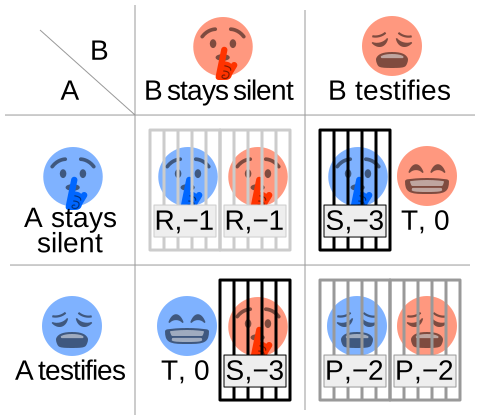
Two criminals are arrested and interrogated separately. Each faces a choice: stay silent (cooperate with each other) or betray the other (defect).
The payoffs:
- Both stay silent: each gets 1 year in prison
- Both betray: each gets 3 years
- One betrays, one stays silent: the betrayer goes free, the silent one gets 5 years
 Source: Wikipedia
The dilemma reveals a troubling truth: betraying is the rational choice for each individual (it’s better regardless of what the other does), yet both would be better off if they could trust each other to stay silent. This demonstrates how individual rationality can lead to collectively worse outcomes.
You see this pattern everywhere: countries in arms races, companies in price wars, athletes doping in sports, overfishing of common resources. Each party has an incentive to defect even though mutual cooperation would benefit everyone.
Coordination Games
These are situations where players benefit from doing the same thing, but there are multiple possible equilibria. The classic example is which side of the road to drive on—it doesn’t matter if everyone drives on the left or right, what matters is that everyone coordinates on the same choice.
Another example: you and a friend get disconnected during a phone call. Do you call back or wait for them to call? If you both call, you get busy signals. If you both wait, nothing happens. You need to coordinate on one person calling and one waiting.
Real-world versions include technology standards (Blu-ray vs HD DVD), meeting points when you lose each other, or even language itself. The challenge isn’t finding the best strategy in isolation, but aligning with what others will do.
The Stag Hunt
This comes from a Rousseau thought experiment. Two hunters can either cooperate to hunt a stag (which requires both of them and provides substantial meat) or individually hunt rabbits (guaranteed small catch).
The payoffs:
- Both hunt stag: both get large payoff
- Both hunt rabbit: both get small but guaranteed payoff
- One hunts stag, other hunts rabbit: stag hunter gets nothing (stag escapes), rabbit hunter gets small payoff
Unlike the Prisoner’s Dilemma, mutual cooperation (hunting stag) is a Nash equilibrium here—it’s the best outcome and stable. But there’s risk: if you commit to the stag and your partner chickens out for the rabbit, you get nothing. The safe rabbit is also an equilibrium.
This represents trust and coordination under uncertainty. Do you take the risk for the better outcome, or play it safe? It models situations like business partnerships, investing in relationships, or collective action problems where cooperation could really pay off but requires mutual trust and commitment.
The key difference from Prisoner’s Dilemma: cooperation is genuinely better and stable here, but fear and lack of trust can still trap you in the inferior equilibrium.
Core Concepts
Nash Equilibrium
A Nash equilibrium is a situation where no player can improve their outcome by changing strategy alone. Think of two cafes choosing locations on a street: they’ll likely cluster near the middle because moving alone would lose customers.
Dominant Strategies
These are choices that work best regardless of what others do. In the Prisoner’s Dilemma, both prisoners have a dominant strategy to betray each other, even though they’d both be better off cooperating.
Zero-Sum vs Positive-Sum
Games can be zero-sum (your gain is my loss, like poker) or positive-sum (we can both benefit, like trade). They can be cooperative (binding agreements possible) or non-cooperative (each player for themselves).
Advanced Topics Worth Exploring
Auction Theory
This studies how different auction formats affect bidding behavior and outcomes. The design of an auction dramatically changes how people bid and who wins.
Main auction types:
English auction (ascending): The familiar format where the price rises until only one bidder remains. Bidders can see competitors and adjust. This tends to reveal true valuations well.
Dutch auction (descending): Price starts high and drops until someone accepts. Used for flowers in the Netherlands. Creates tension—wait too long and someone else grabs it.
First-price sealed-bid: Everyone submits one secret bid, highest wins and pays what they bid. Strategy involves guessing others’ valuations and bidding below your true value to maximize profit if you win.
Second-price sealed-bid (Vickrey auction): Highest bid wins but pays the second-highest bid. Remarkably, your dominant strategy is to bid your true valuation—no need for games. This is what eBay approximates with automatic bidding.
A key insight: The Revenue Equivalence Theorem shows that under certain conditions, all these formats generate the same expected revenue for the seller. What differs is information revelation, simplicity, and vulnerability to collusion.
Real applications include Google Ads auctions, spectrum license sales (telecommunications auctions are worth billions), treasury bonds, and eBay.
Voting Paradoxes
These show how seemingly reasonable voting systems can produce bizarre or contradictory results.
Condorcet’s Paradox: Group preferences can be cyclic even when individuals are rational. Imagine three voters ranking three options:
- Voter 1: A > B > C
- Voter 2: B > C > A
- Voter 3: C > A > B
In pairwise votes: A beats B (2-1), B beats C (2-1), C beats A (2-1). Society prefers A to B, B to C, but C to A! There’s no clear “will of the people.”
Arrow’s Impossibility Theorem: Kenneth Arrow proved that no voting system can simultaneously satisfy a small set of seemingly reasonable criteria when there are three or more options. You literally cannot design a “fair” voting system that meets basic requirements—something must give.
Strategic voting: Sometimes voting for your true favorite is irrational. In first-past-the-post elections, you might vote for your second choice if your favorite “can’t win”—this is why third parties struggle. The system incentivizes dishonesty.
Spoiler effects: A candidate entering the race can change who wins among the remaining candidates, even if the newcomer has no chance.
Evolutionary Game Theory
This applies game theory to biology and evolution, asking: which strategies survive over time through natural selection?
The key difference from classical game theory: Players don’t consciously choose strategies. Instead, strategies that do well reproduce more, becoming more common in the population. It’s Darwin meets Nash equilibrium.
Evolutionarily Stable Strategy (ESS): A strategy that, if adopted by most of the population, cannot be invaded by any alternative strategy. It’s like a Nash equilibrium that’s also robust to mutation and drift.
Hawk-Dove game: Imagine animals competing for resources. “Hawks” always fight aggressively; “Doves” display but retreat if challenged. If everyone’s a Hawk, lots of costly injuries. If everyone’s a Dove, encounters are peaceful but inefficient. The ESS is usually a mixed population—some Hawks, some Doves, creating a stable balance.
Applications extend beyond biology to explain human cooperation, cultural evolution, immune system dynamics, and even business strategy. The beauty of this framework is that it explains cooperation and altruism without assuming rationality or foresight.
The Broader Landscape
Game theory extends into numerous specialized areas:
Repeated and iterated games transform one-shot interactions. The Prisoner’s Dilemma completely changes when played multiple times—cooperation becomes rational because you can punish defection in future rounds. This explains why reputation matters in business and why ongoing relationships differ from one-offs.
Bargaining and negotiation theory provides frameworks for how to split resources fairly. The Ultimatum Game shows people reject unfair offers even at personal cost, while the Nash Bargaining Solution provides a “fair” split based on what each party could get alone.
Mechanism design (reverse game theory) involves designing the rules of games to achieve desired outcomes. Want people to bid truthfully in auctions? Design a Vickrey auction. Want efficient matching of students to schools? Use the deferred acceptance algorithm. This field designs kidney exchange programs, spectrum auctions, and dating apps.
Signaling games address how you communicate when you have private information and incentives to lie. A peacock’s tail signals genetic fitness (expensive to fake). Job applicants signal ability through education. Companies signal quality through warranties.
Matching theory determines how to pair people when both sides have preferences. The Gale-Shapley algorithm produces stable marriages and matches, used in medical residency matching, school choice systems, and organ donation networks.
Network games study decisions that depend on neighbors in a network. Technology adoption spreads through social networks. Bank runs cascade. This explains viral trends, systemic risk in finance, and network effects in technology platforms.
Behavioral game theory acknowledges that real humans aren’t perfectly rational. They’re affected by fairness concerns, framing effects, bounded rationality, and social norms. This field tests game theory in labs and finds systematic deviations, leading to better models.
Game Theory and Office Politics
Game theory isn’t just abstract mathematics—it’s a formalization of office politics that explains why certain dynamics persist.
Repeated Games and Reputation
You’re not playing one-shot interactions at work. Your coworker who you screw over today will remember it for years. This transforms the game completely—suddenly cooperation becomes rational self-interest. The shadow of the future makes reputation valuable.
This is why “tit-for-tat” works: be cooperative by default, but punish defection, then forgive. People learn you’re good to work with but not a pushover.
Signaling and Performative Work
Why do people send emails at 11 PM or schedule unnecessary meetings? They’re signaling. Like a peacock’s tail, late-night emails signal “I’m committed” even if the actual work is mediocre. Staying late signals dedication whether you’re productive or not.
The signal only works because it’s costly to fake—that’s why it persists even though everyone knows it’s partly theater. Your challenge: figure out which signals actually correlate with quality in your workplace and ignore the rest.
Coordination Games and Bad Practices
Everyone knows the daily standup is useless, but it continues because changing requires coordination. If you skip it alone, you look uncooperative. Everyone needs to agree to stop, but there’s no mechanism to coordinate that agreement.
Same with pointless reporting, inefficient tools, or broken processes. This is why “be the change” often fails—you’re trying to unilaterally move from one equilibrium when success requires group coordination.
The Promotion Tournament
You’re not just competing on merit—you’re managing perceptions, alliances, and visibility. The Nash equilibrium isn’t “do great work quietly.” It’s often “do visible work, build alliances with decision-makers, and manage your brand.”
The person who takes credit for team work isn’t being irrational—they understand the game better. Annoying, but game-theoretically sound.
Principal-Agent Problems
Your manager’s incentives aren’t perfectly aligned with yours or the company’s. They might prefer visible short-term wins over long-term technical debt reduction because they’ll be promoted before the debt explodes.
You face moral hazard—they can’t perfectly observe your effort, only outcomes (which include luck). This explains micromanagement (attempting to reduce information asymmetry) and why metrics get gamed (Goodhart’s Law: when a measure becomes a target, it ceases to be a good measure).
Coalition Formation
Who allies with whom? In cooperative game theory, stable coalitions form when no subset can do better by splitting off. Office cliques are coalition equilibria.
The “core” is the set of allocations (who gets credit, resources, influence) where no sub-group would rather break away. This explains why certain team compositions feel stable while others have constant drama—they’re not at an equilibrium point.
Information Asymmetry
You know things your manager doesn’t (how hard tasks really are, who actually did the work, technical tradeoffs). Your manager knows things you don’t (budget constraints, political pressures, strategic direction). Both of you have incentives to misrepresent.
Screening mechanisms: your manager gives you difficult projects to separate high from low performers. Signaling: you volunteer for visible high-risk projects to demonstrate capability.
Brinkmanship in Conflicts
Two managers both want budget for their projects. Who backs down? It’s a game of chicken—the one who seems more committed (or crazy enough not to back down) often wins. This explains why some people escalate conflicts irrationally—they’re establishing reputation for future games.
Tragedy of the Commons
Meeting rooms, engineering time, attention from senior leadership—all commons that get overused. Each team rationally overschedules because they don’t bear the full cost of congestion. Individual rationality leads to collective dysfunction.
Cheap Talk vs Costly Signals
Anyone can say “I’m committed to this project.” That’s cheap talk—costless and therefore not credible. What’s costly? Actually doing the work, putting your reputation on the line, or allocating your scarce time. This is why managers learn to ignore verbal commitments and watch actual behavior.
Mixed Strategy Equilibria in Visibility
Should you speak up in every meeting or stay quiet? Pure strategies fail—always speaking makes you annoying, never speaking makes you invisible. The equilibrium is probabilistic: speak up when you have something valuable, creating uncertainty about whether you’ll contribute. This keeps people paying attention when you do talk.
Backward Induction in Career Planning
Think backward from where you want to be. To be VP, you typically need to be Director. To be Director, you need X, Y, Z experiences. This reveals which projects are strategically valuable versus dead ends.
The people who seem to make suspiciously good career moves are doing this backward induction while others react to immediate opportunities.
The Real Game
Office politics is an iterated multiplayer Prisoner’s Dilemma with incomplete information, reputation effects, and coalition formation. You’re simultaneously:
- Building/maintaining reputation (repeated game)
- Managing information asymmetries (signaling/screening)
- Forming alliances (coalition formation)
- Balancing cooperation versus competition (Prisoner’s Dilemma)
- All while partially uncertain about payoffs and others’ types
Practical Implications
For those with technical backgrounds, there’s often a tendency to underweight the political game relative to technical merit. The Nash equilibrium in most offices includes some political play—zero is rarely optimal even if excessive politicking is counterproductive.
The question isn’t “should I play office politics” but “what’s the minimal effective dose of political awareness needed to not get exploited while focusing on actual work?”
Understanding game theory doesn’t make you a ruthless political operator—it helps you see the strategic landscape clearly, predict behavior, and make better decisions about when to cooperate, when to compete, and how to build sustainable long-term relationships.
Conclusion
Game theory provides a powerful lens for understanding strategic interactions in business, politics, biology, and daily life. From the simple elegance of the Prisoner’s Dilemma to the complex dynamics of office politics, these mathematical frameworks reveal the hidden structures beneath human behavior.
The real power of game theory isn’t in calculating optimal strategies—it’s in recognizing which game you’re playing, understanding the incentives at work, and seeing how individual rational choices create collective outcomes. Once you see the world through this lens, you can’t unsee it.
Want to explore further? Start with “The Evolution of Cooperation” by Robert Axelrod for repeated games, “Thinking Strategically” by Dixit and Nalebuff for accessible applications, or dive into “Game Theory: An Introduction” by Steven Tadelis for rigorous foundations.